
The Corporate Starwashing Blanketing Earth’s Atmosphere with Endless Space Debris
~2.5 minute read
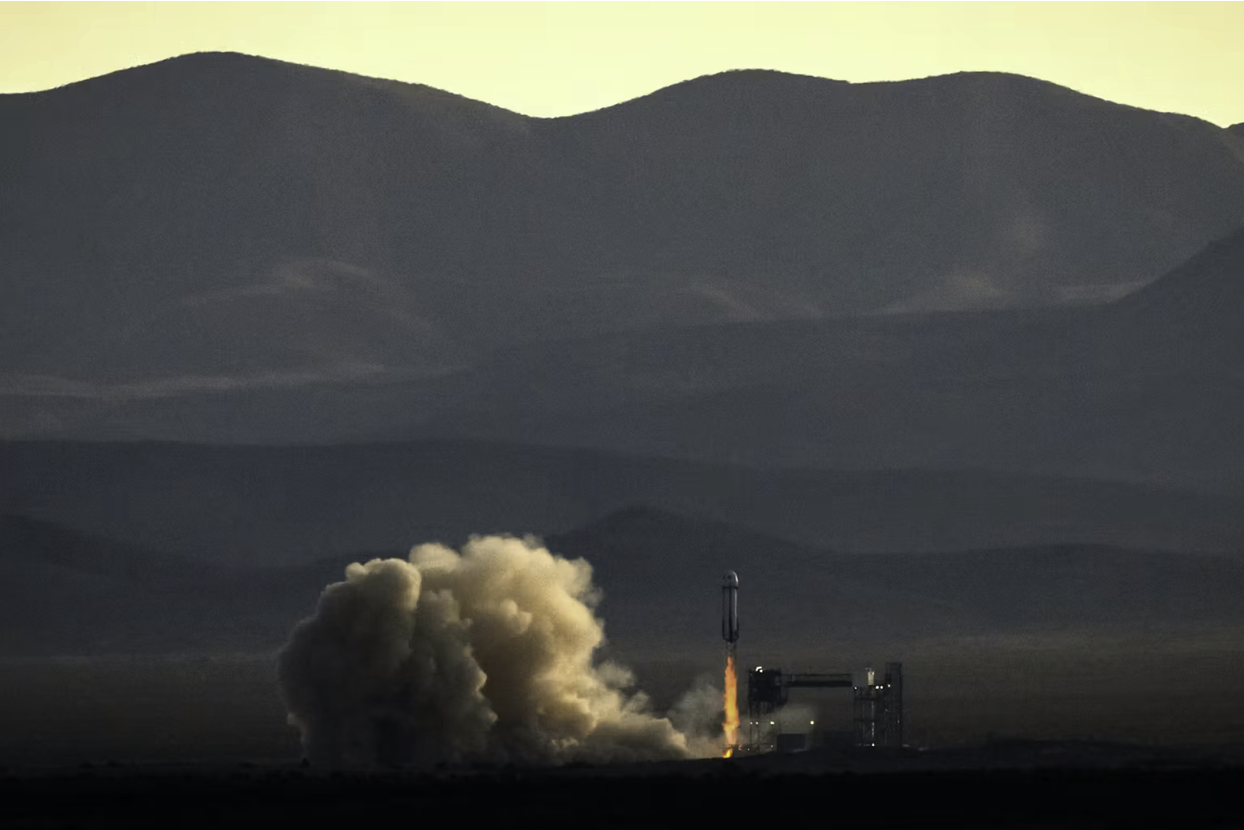
Photo by Justi Hamel on Getty Images, The Conversation
In the late 20th century, both America and the USSR were fiercely locked in a space race that lasted a little more than a decade from 1957 to 1969 until America became the first country to land its astronauts, Neil Armstrong and Buzz Aldrin, on the moon. About seventy years later, America is embroiled in another space race. This time though, critics such as Melissa E. Yingling from the University of Louisville accuse modern space companies such as SpaceX and Blue Origin of starwashing.
Based on the term “greenwashing”, Yingling herself adapted starwashing to refer to space companies selectively portraying the good in space voyages, policies, and advances while downplaying their negative environmental effects on Earth and its climate. Even though SpaceX and Blue Origin claim that their space voyages help pioneer the future of human exploration, they conveniently avoid discussing how those same trips have also polluted layers of Earth’s atmosphere as deep as the stratosphere and amplified Earth’s already worsening greenhouse gas emissions. According to orbveil, close to 130 million fragments smaller than 1 cm were recorded in Low Earth Orbit (LEO) in February 2026; about six months later, Orbital Radar updated that figure skyrocketing to more than 140 million, highlighting how the recent uptick in space travel has contributed to the sudden increase in debris alongside the ~22,400 tracked objects already crowding the region.
Regardless whether these fragments or space junk came from exploded fuel tanks, discarded mission hardware, or previous orbital collisions, they are more than capable of tearing through a spacecraft’s hull or even completely shattering an entire satellite. But the damage that these fragments can cause are not limited to space craft as they can also blind global weather satellites, collapse GPS networks, and completely shut down internet access on Earth. Yet, the worst part is that these meteor-like debris are completely manmade, and that 80% of it is shared between the United States, Russia, and China. Instead of America competing against Russia again in the 21st century space race, America’s excessive space travels are only hurtling the planet closer to an inescapable climate crisis rather than the next frontier of human exploration in space.
As the space economy edges itself closer to spending $1.8 trillion by 2035, the true hidden costs of those space trips are being felt by the public, and especially those who live near space launch sites. Until the space industry faces harsher regulations and penalties, though, since pre-existing environmental lawsuits such as Texas General Land Office v. SaveRGV, Cameron County v. SaveRGV, and Paxton v. SaveRGV have been either dismissed or gridlocked in court, billionaires such as Musk and Bezos will continue to prioritize orbital dominance over Earth’s increasingly fragile biosphere.